Voip and pbx Solution

VOIP

VoIP Service providers usually terminate off-net calls at rates that are considerably lower than those of traditional Telco’s. Future IT Solutions rates are typically 50% cheaper than Telkom and the Mobiles for Domestic Calls.

VoIP on-net calls are usually free. Multiple branches of the same company on the Future IT Solutions VoIP network, or suppliers/customers on the Future IT Solutions VoIP network, call one another for free. Many other providers charge between branch to branch calls.

Free International Roaming: International roaming on VoIP is usually free. Because VoIP is internet-based, calls placed while travelling in foreign countries are still billed at exactly the same rates as they are in South Africa and in SA currency; no additional roaming charges apply. However, foreign data charges apply to VoIP data as they do to any other form of data consumption.

PABX

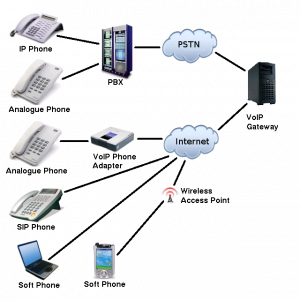
Future IT Solutions offers cost effective PABX Solutions for businesses. Our PABX solution can grow from a one man organisation to over 500 employees over multiple sites. Future IT Solutions PABX is complete IP and uses existing network infrastructure to functions. You can also enjoy the benefit of using a VOIP or GSM solutions with the PABX to made cheaper calls. Some of our solutions allow companies to use their existing analogy phones with our PABX. Below are some of our benefits and features.

+ Easy to use
Easy to deploy and manage via web-based configuration interface
+ Robust all-in-one features
Deliver enterprise-class communication features and functionality
+ Modular Technology
Customizable combination of FXO, FXS, BRI, GSM, and UMTS modules
+ Match your IP phone
Perfect interoperability with major IP Phones
+ Speak your language
Multi-languages web GUI and voice prompts
+ No future licensing fees
Scalable with plug-and play ease without licensing

+ Enhanced security
Secure your communication from attack and abuse with firewall.
+ Energy Saving
Low power consumption for your green

Security
+ Firewall
+ SIP TLS transport
+ SRTP (RTP encryption)
SMS Features
+ Email to SMS
+ SMS to Email

Advanced Features
Ÿ Call Recording
Ÿ Direct Inward System Access (DISA)
Ÿ Distinctive Ringtone
Ÿ Dial by Name
Ÿ LDAP Server
Ÿ Mobility Extension
Ÿ One touch recording
Ÿ Phone Provisioning for Aastra, Cisco, Escene, Fanvil, Grandstream, Panasonic, Polycom, Snom, Yealink IP Phones
Ÿ QoS (voice quality)
Ÿ Redundancy (Hot Standby)
Ÿ Route by Caller ID
Ÿ Spy functions (Normal Spy, Whisper Spy, Barge Spy)
Ÿ Static Route

Basic Features

~ Automated Attendant (IVR)
~ Attended Transfer
~ Blind Transfer
~ Blacklist
~ Call Back
~ Call Detail Records (CDR)
~ Call Forward
~ Call Parking

~ Call Pickup
~ Call Routing
~ Call Waiting
~ Caller ID
~ Conference
~ Do Not Disturb (DND)
~ Follow me
~ Intercom/Zone Intercom

~ Music on Hold
~ Music on Transfer
~ Queue
~ Ring Group
~ Skype Integration (Skype Connect)
~ Speed Dial
~ Voicemail

1. Lower Infrastructure Costs

Network Infrastructure
Because VoIP is just another IP-based service like smtp (email), ftp (file transfer), http (browsing) etc. it can be carried together with all other data on coverged IP networks. VoIP therefore reduces cabling requirements and improves bandwidth efficiency by eliminating the need for:
a) Dedicated voice network cabling on the customer’s site by migrating voice traffic to the customer’s LAN, and
b) Dedicated Analogue, BRI (basic rate ISDN) and PRI (primary rate ISDN) lines to the voice service provider by migrating voice trunk traffic to the customer’s broadband connection (WAN).

Voice Infrastructure
The Capex requirements of extensions on VoIP PABXs are lower than on traditional, analogue PABXs. VoIP PABXs may run on commodity hardware such as PCs (e.g. the popular Asterisk open-source PABX), and use standard interfaces instead of closed architectures.

2. Increased Functionality

Cross Platform: Unlike a fixed-line or mobile service, a VoIP user can use virtually any internet-enabled device to make and receive calls on his/her VoIP Account. i.e. PCs and laptops (using VoIP “softphone” software), mobile phones & tablets (using VoIP Apps) and VoIP desk phones.

Easy Relocation & No Geographical Limitation: Not only can a VoIP account be shared across multiple devices, it is also accessible from wherever an internet connection is available – even overseas.

Unified Communications: Business VoIP Solutions have evolved into unified communications services that treat all communications – phone calls, faxes, voice mail, e-mail, web conferences and more as discrete units that can all be delivered via any means and to any IP-capable device, including PCs, handsets, cell phones and tablets.

3 Convenience

User Manageability: VoIP devices have simple, intuitive user interfaces, so users can often make simple system configuration changes. VoIP service providers usually provide comprehensive online self-management applications to their customers, allowing them to manage their VoIP accounts.

Choice: Unlike a fixed-line or mobile service, a customer can elect to sign-up for their voice (VoIP service with a service provider other than one providing their access connectivity.

Levelling the Playing Field for SMEs: Smaller companies can adopt a large organizational image by having a single office with multiple national or international phone numbers while gaining increased functionality and flexibility and saving costs.

Request Quote